
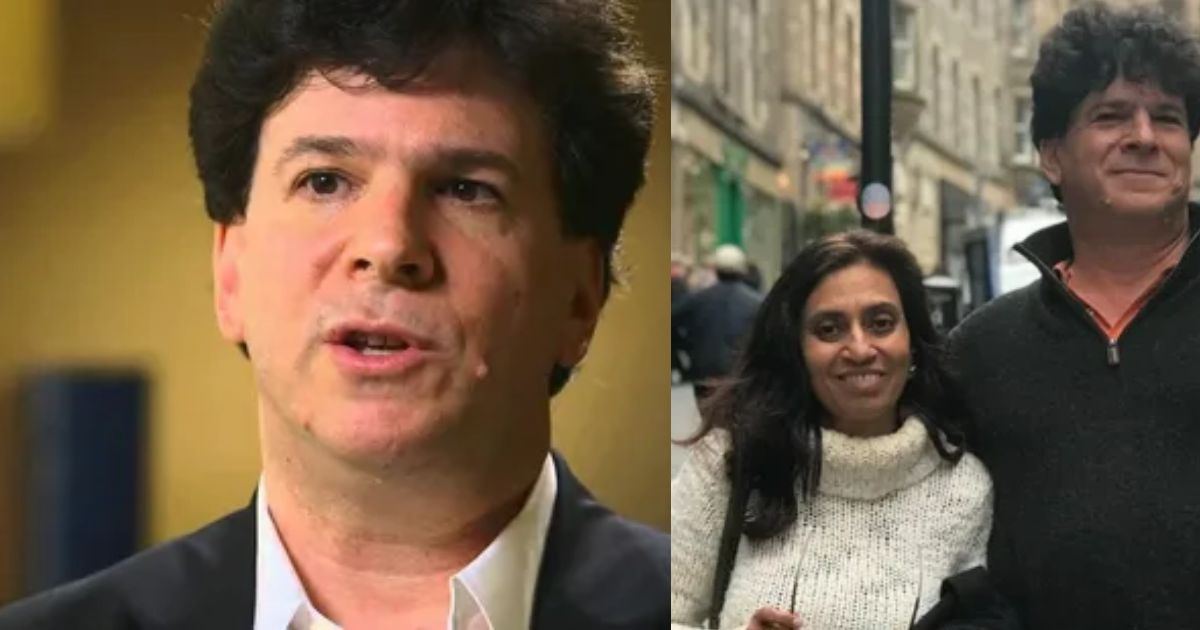
| Quick Facts | Details |
|---|---|
| Full Name | Eric David Weinstein |
| Date of Birth | October 26, 1965 |
| Birthplace | Los Angeles, California |
| Nationality | American |
| Education | PhD, Mathematical Physics, Harvard University |
| Known For | Geometric Unity Theory, The Portal Podcast, Thiel Capital |
| Occupation | Mathematician, Economist, Podcast Host, Managing Director |
| Estimated Net Worth (2026) | $5–10 Million |
| Spouse | Pia Malaney |
Introduction: Who Is Eric Weinstein and Why His Net Worth Matters
Some people are difficult to categorize. Eric Weinstein is one of them. He’s simultaneously a mathematician with a Harvard PhD, a managing director at one of Silicon Valley’s most influential venture capital firms, a podcast host who regularly sits across from the world’s most consequential thinkers, and a public intellectual who coined the term “Intellectual Dark Web.” Trying to understand his Eric Weinstein net worth means understanding all of those roles simultaneously — because each one contributes to a financial picture that’s genuinely complex.
Why does Eric Weinstein’s wealth matter beyond simple curiosity? Because it illuminates something important about how intellectual capital translates into financial capital in the twenty-first century. His career path — from pure mathematics to economic theory to venture capital to media — represents a specific modern archetype: the polymathic thinker who finds that ideas, when properly positioned and communicated, generate real financial returns. Understanding Eric Weinstein net worth 2026 means understanding that equation in concrete terms.
Early Life and Education of Eric Weinstein
Birth and Background
Eric David Weinstein was born on October 26, 1965, in Los Angeles, California. He grew up in a household where intellectual curiosity was not just permitted but expected. His brother, Bret Weinstein — who later became publicly prominent through the Evergreen State College controversy and his own podcast — suggests a family environment where ideas were taken seriously and debate was a normal mode of communication. That early environment shaped the intellectual disposition that would eventually drive every significant career choice Eric Weinstein made.
Growing up in Los Angeles during the late 1960s and 1970s exposed him to the particular cultural cocktail that the city offered — technology optimism, creative ambition, and a sense that the rules governing other American cities didn’t necessarily apply there. For a mathematically gifted child, that environment was genuinely stimulating. The path from Los Angeles childhood to Harvard graduate program wasn’t obvious or inevitable but it reflects the consistent application of exceptional intellectual gifts from an early age.
Academic Journey
Eric Weinstein’s academic journey represents one of the more impressive educational trajectories in contemporary intellectual life. He completed his undergraduate education before pursuing graduate study at Harvard University, where he earned a PhD in Mathematical Physics — one of the most demanding intersections of two already demanding disciplines. Mathematical physics requires genuine mastery of both abstract mathematics and physical theory simultaneously, a combination that filters all but the most exceptional students.
His doctoral work at Harvard placed him in one of the world’s most intellectually competitive environments. Harvard’s mathematics and physics departments have historically housed Nobel laureates, Fields Medal winners, and the foundational thinkers of modern theoretical science. Navigating that environment successfully — earning a doctorate rather than simply attending — required sustained performance at the highest academic level. That credential became the foundation upon which every subsequent professional achievement was built, providing intellectual credibility that no amount of networking or positioning could substitute.
Career Journey and Major Roles of Eric Weinstein
Transition from Academia to Finance
The jump from mathematical physics academia to finance might look surprising on paper. In practice, it reflects a pattern that Wall Street and Silicon Valley have exploited systematically for decades — the recognition that rigorous mathematical training transfers with remarkable effectiveness to financial modeling, quantitative analysis, and economic theory. Eric Weinstein made that transition in a way that honored both sides of his background rather than abandoning one for the other.
His work in economics and finance drew on his mathematical training in ways that produced genuinely novel thinking. He’s been publicly credited with contributions to economic theory, including work with economist Pia Malaney — who later became his wife — on index theory applied to economic measurement. That collaborative work demonstrated that his mathematical sophistication could generate insights that conventional economics, working with less rigorous tools, had missed entirely. The transition from academia to finance wasn’t a retreat from intellectual ambition. It was a redirection of it toward domains with more immediate real-world application.
Managing Director at Thiel Capital
The most significant single contributor to Eric Weinstein’s income is almost certainly his role as Managing Director at Thiel Capital, the investment vehicle of Peter Thiel — PayPal co-founder, Facebook’s first outside investor, and one of Silicon Valley’s most influential and controversial figures. Eric Weinstein has held this role since 2013, and its financial implications are substantial.
Managing Director positions at venture capital and private equity firms of Thiel Capital’s caliber carry compensation packages that typically combine a substantial base salary with carried interest — a share of investment profits that can generate enormous payouts when portfolio companies succeed. Peter Thiel’s investment track record includes early stakes in Facebook, Palantir, SpaceX, and dozens of other companies that generated returns in the hundreds or thousands of percent. Whether Eric Weinstein participates meaningfully in those returns through carried interest arrangements is not publicly disclosed, but the structure of such roles at firms of this caliber makes significant performance-based compensation entirely plausible.
Geometric Unity Theory Explained
What Is Geometric Unity?
Geometric Unity is Eric Weinstein’s proposed theoretical framework for unifying the fundamental forces of physics — essentially, his attempt to accomplish what Albert Einstein spent the last decades of his life pursuing and what theoretical physicists have been working toward for a century. The theory attempts to reconcile general relativity and quantum mechanics by proposing a 14-dimensional mathematical framework from which the standard model of particle physics might be derived.
Eric Weinstein first publicly presented Geometric Unity in a lecture at Oxford University in 2013, introduced by Marcus du Sautoy. The presentation generated significant attention and significant controversy simultaneously — attention because the ambition of the project was genuinely extraordinary, controversy because it was presented publicly before undergoing standard peer review processes. The theory subsequently received more formal documentation when Eric Weinstein published a paper outlining its mathematical foundations, though the mainstream physics community has remained cautious about its claims.
Why It Matters
Geometric Unity matters to Eric Weinstein’s story — including his financial story — for reasons that go beyond pure physics. The theory is central to his public intellectual identity. It’s why people who might otherwise dismiss him as “just a finance guy” take him seriously as an original thinker. It’s why conversations about Eric Weinstein in intellectual circles carry a weight that purely financial or media careers wouldn’t generate. Whether or not Geometric Unity ultimately proves to be the theoretical breakthrough he believes it to be, its existence as a serious intellectual project colors everything else he does and says.
The Portal Podcast and Media Appearances

Hosting The Portal Podcast
The Portal podcast, which Eric Weinstein launched in 2019, became one of the most intellectually ambitious podcasts in the rapidly expanding medium. Where most podcasts aimed for accessibility and volume — short episodes, frequent releases, broad topics — The Portal aimed for depth, density, and genuine intellectual engagement. Episodes ran long. Guests included Nobel laureates, mathematical physicists, controversial thinkers, and figures from the fringes of mainstream intellectual discourse.
The podcast built an audience that was smaller than Joe Rogan’s but more intensely engaged — the kind of listeners who return to episodes multiple times, share specific timestamp discussions, and participate in extended online conversations about the ideas raised. That audience quality translated into meaningful media influence even without top-tier download numbers. The Portal was never primarily a revenue vehicle. It was an influence vehicle — and in Eric Weinstein’s career, influence has consistently been the lever that unlocks financial opportunity.
Media Presence
Beyond his own podcast, Eric Weinstein has appeared on some of the highest-profile media platforms available to public intellectuals. His appearances on Joe Rogan’s podcast alone — one of the most listened-to podcasts in the world — have exposed his ideas and his persona to audiences numbering in the millions. He’s been a regular presence on YouTube channels, podcasting networks, and intellectual forums where his combination of mathematical credibility and provocative commentary generates genuine engagement.
His media presence contributes to his net worth indirectly but significantly. Every appearance increases name recognition, strengthens his brand as a public intellectual, and creates downstream opportunities — speaking engagements, consulting inquiries, media collaborations — that translate into actual income. The media presence he has built since 2013 functions as a sustained marketing campaign for his intellectual brand, one that has made him one of the more recognizable figures in contemporary American intellectual discourse.
Read More: Chip Batchelder Net Worth Revealed: Income, Career Success & Wealth Breakdown
Eric Weinstein’s Wife, Family, and Personal Life
Eric Weinstein’s wife is Pia Malaney, an economist who holds a PhD from Harvard and is Director of the Economic Research at the Parasite Without Borders organization and a former researcher connected to the Santa Fe Institute. Their academic collaboration predates their marriage — they worked together on applying differential geometry to economic index theory, producing work that demonstrated genuine mathematical innovation in economic measurement.
Their relationship is one of genuine intellectual partnership rather than simply personal companionship. Pia Malaney’s own academic credentials are formidable — she studied under distinguished economists and produced doctoral work that Eric Weinstein has described publicly as deserving of greater recognition than it received. Together they have children, though the family maintains appropriate privacy around their children’s details. The Weinstein family’s intellectual environment — two Harvard PhDs who think seriously about mathematics, economics, and big ideas — presumably creates an unusual household dynamic that mirrors in some ways the family environment Eric Weinstein himself grew up in.
Main Sources of Income for Eric Weinstein
Primary Income Sources
Eric Weinstein’s wealth flows from several distinct streams that combine in ways that make precise estimation genuinely difficult. Understanding each stream separately provides the clearest picture available of how his total financial picture assembles itself.
| Income Source | Estimated Contribution | Notes |
|---|---|---|
| Thiel Capital (Managing Director) | Primary / Largest | Base salary + potential carried interest |
| Podcast Revenue (The Portal) | Secondary | Sponsorships, Patreon-style support |
| Speaking Engagements | Tertiary | Conference fees, institutional appearances |
| Consulting / Advisory | Possible | Not publicly confirmed |
| Media Appearances | Indirect | Brand-building rather than direct payment |
| Investment Returns | Possible | Personal investment portfolio undisclosed |
Income Streams and Wealth Drivers
The architecture of Eric Weinstein’s income reflects his unusual career positioning. Most people earn money from one primary source with modest secondary contributions. His income structure is more diversified — deliberately so, it seems, given how purposefully he has cultivated multiple simultaneous professional identities.
His Thiel Capital role provides financial stability and likely generates the majority of his income through compensation structures typical of senior roles at investment firms of that caliber. His media work generates influence that multiplies the value of every other professional activity. His intellectual reputation — built on Geometric Unity, on coining the Intellectual Dark Web concept, on his Harvard credentials — provides credibility that commands premium pricing for speaking engagements and advisory roles. These streams reinforce each other in ways that make the total considerably more valuable than the sum of its parts.
Eric David Weinstein Insider Ownership Reports
Public records related to Eric David Weinstein and insider ownership are limited, reflecting the private nature of Thiel Capital as an investment vehicle. Unlike publicly traded companies where insider ownership must be disclosed to regulatory authorities, private investment firms operate under significantly reduced transparency requirements. What is publicly known is that Eric Weinstein holds a senior role at Thiel Capital and that the firm manages substantial assets across venture capital, private equity, and other investment strategies.
Any insider ownership stakes Eric Weinstein might hold in Thiel Capital portfolio companies would not be subject to standard public disclosure requirements. This opacity is entirely legal and entirely common in private investment management. It also means that a significant potential component of his wealth — carried interest stakes in successful portfolio companies — is completely invisible to external observers trying to estimate his net worth. The honest acknowledgment here is that insider ownership information for Eric Weinstein simply isn’t available in the public record.
Finance and Venture Capital Earnings
Venture capital compensation at the managing director level follows a structure that can generate dramatically variable annual income depending on fund performance. The standard “2 and 20” model — a 2% annual management fee plus 20% of investment profits — means that in years when portfolio companies generate strong returns, senior partners and managing directors can receive compensation that dwarfs their base salaries by enormous multiples.
Peter Thiel’s investment record includes some of the most spectacular returns in venture capital history. His early Facebook investment returned approximately 2,000 times its initial value. Palantir, which he co-founded, eventually went public at a valuation in the billions. SpaceX investments have generated extraordinary returns. Whether Eric Weinstein’s compensation structure at Thiel Capital includes meaningful participation in these returns is unknown — but his tenure since 2013 coincides with a period of significant venture capital wealth generation. Even modest carried interest participation in funds of this caliber could contribute substantially to his overall net worth.
Media, Speaking Engagements, and Intellectual Influence
Public intellectuals at Eric Weinstein’s level of recognition command speaking fees that typically range from $20,000 to $100,000 per engagement, depending on the audience, venue, and topic. His combination of mathematical credibility, financial industry experience, and media visibility places him in a category of speakers that organizations pay premium rates to access. Universities, financial firms, technology conferences, and intellectual forums all represent potential speaking clients.
His intellectual influence also generates income indirectly through consulting opportunities that don’t necessarily get publicized. Firms that value unconventional thinking, hedge funds looking for perspectives outside mainstream economic consensus, and technology companies navigating complex theoretical questions all represent potential consulting clients for someone with his unique combination of skills. Whether he pursues these opportunities actively is not publicly documented but the demand for them almost certainly exists.
Investments and Assets
Known Asset Categories
| Asset Category | Status |
|---|---|
| Real Estate | Likely (location undisclosed) |
| Stock Portfolio | Possible (details private) |
| Private Company Stakes | Possible through Thiel Capital connections |
| Intellectual Property | Geometric Unity, podcast catalog |
| Cash and Liquid Assets | Unknown |
Eric Weinstein’s investment portfolio is not publicly documented. What can be reasonably inferred is that someone with his financial sophistication, his proximity to some of Silicon Valley’s most successful investors, and his compensation from Thiel Capital has likely deployed capital into investment vehicles beyond simple savings accounts. The specific nature of those investments — whether concentrated in technology, diversified across asset classes, or structured in more complex ways — is genuinely unknown.
How His Investments and Ventures Add to His Wealth
The compounding effect of his various professional activities on overall wealth is significant even when individual contribution amounts are unknown. His Thiel Capital role provides both income and access — access to investment opportunities, to networks of wealthy and influential people, and to information flows that aren’t available to most investors. That access has compounding value that goes beyond the direct compensation the role provides.
His media ventures don’t just generate podcast revenue. They generate the kind of name recognition that opens doors — to speaking opportunities, to media collaborations, to advisory roles with organizations that value the credibility his intellectual reputation provides. Every appearance that expands his audience slightly increases the financial value of his brand, even when the appearance itself is unpaid or minimally compensated.
Estimated Net Worth in 2024–2025
Eric Weinstein’s net worth is estimated by various sources at between $5 million and $10 million, with some estimates ranging as high as $15 million when accounting for potential carried interest and private investment stakes. The honest acknowledgment is that without access to his financial disclosures — which don’t exist as public documents — any estimate carries significant uncertainty.
What’s most defensible is a range rather than a precise figure. The lower bound of meaningful estimates reflects his confirmed income from Thiel Capital at senior management level over more than a decade of tenure. The upper bound reflects the possibility that carried interest participation and private investment returns have added substantially to that base. The $5–10 million range represents the most defensible estimate given available information.
Eric Weinstein Net Worth Estimates (2019–2025)
| Year | Estimated Net Worth | Key Drivers |
|---|---|---|
| 2019 | $3–5 Million | Thiel Capital tenure, early podcast launch |
| 2020 | $4–6 Million | Portal podcast growth, media appearances |
| 2021 | $5–7 Million | Intellectual Dark Web prominence, speaking fees |
| 2022 | $5–8 Million | Continued Thiel Capital role, investment growth |
| 2023 | $6–9 Million | Podcast influence, venture capital market recovery |
| 2024 | $6–10 Million | Sustained media presence, Thiel Capital compensation |
| 2025 | $7–10 Million | Compounding investment returns, speaking demand |
What Factors Influence His Net Worth
Positive Factors
Eric Weinstein’s wealth trajectory benefits from several powerful tailwinds. His Thiel Capital position provides stable, high-quality income from one of venture capital’s most credible platforms. His intellectual brand — built on genuine mathematical credentials rather than manufactured public persona — is durable in ways that celebrity-based brands often aren’t. His podcast catalog represents accumulated intellectual property that continues generating value. His speaking market benefits from his unusual combination of finance, mathematics, and media — a profile that’s rare enough to command premium pricing.
Negative Factors
Uncertainty around Geometric Unity’s eventual academic reception could affect his intellectual credibility if the theory is definitively rejected by mainstream physics. His public intellectual positioning — often contrarian, sometimes provocative — creates reputational risks that could affect speaking opportunities and media relationships. The private nature of his income sources means that any disruption to his Thiel Capital role would significantly affect the financial picture in ways that public-facing careers are more insulated from.
Why Net Worth Estimates Vary So Widely
Key Reasons
The range of estimates for Eric Weinstein’s net worth across different sources is genuinely wide — from under $5 million to over $15 million — for reasons that are worth understanding clearly rather than simply averaging together.
First, his primary income source is a private firm with no public disclosure requirements. Second, potential carried interest income is both enormous in theory and completely unverifiable in practice. Third, his intellectual property and brand value are real assets that don’t appear on any balance sheet but genuinely affect his financial capacity. Fourth, speculation about his personal investment portfolio — given his access and sophistication — varies wildly. Fifth, the nature of his role at Thiel Capital has never been publicly defined in compensation terms, leaving estimators to apply industry benchmarks that may not accurately reflect his specific arrangement.
Public Image, Media Work, and Financial Impact
Eric Weinstein’s public image is that of a rigorous outsider — someone with impeccable establishment credentials (Harvard PhD, Thiel Capital) who nonetheless positions himself as a critic of institutional failures in science, academia, and media. That positioning is both intellectually coherent and commercially effective. It creates a distinctive brand identity that appeals to audiences skeptical of mainstream institutions while remaining credible to those institutions themselves.
His media work reinforces that image consistently. Whether on his own podcast, on Joe Rogan, or in written commentary on social platforms, he presents ideas with mathematical rigor and institutional familiarity while maintaining the outsider’s critical perspective. That combination commands genuine attention in ways that pure insiders and pure outsiders rarely achieve. The financial impact of that media positioning compounds over time as his audience grows more loyal and more engaged.
Influence, Lifestyle, and What His Wealth Represents
Eric Weinstein’s lifestyle, from available public information, is intellectually focused rather than conspicuously consumptive. He doesn’t project wealth through the typical markers — he doesn’t discuss luxury assets, doesn’t appear in social settings associated with ostentatious consumption, and doesn’t present himself as wealthy in the way that many financially successful public figures do. His identity is built around ideas rather than possessions.
What his wealth represents, in the broader context of his career, is the financial validation of a specific theory about how intellectual value should be organized and compensated. He has argued publicly that the academy systematically undervalues and undercompensates genuinely original thinkers. His own financial trajectory — from academic mathematics to venture capital to media influence — represents one possible answer to the question of how such thinkers can achieve financial security without compromising intellectual independence.
Comparison with Similar Public Figures
| Public Figure | Estimated Net Worth | Primary Income Source |
|---|---|---|
| Eric Weinstein | $5–10 Million | Thiel Capital, media, speaking |
| Jordan Peterson | $8–12 Million | Books, speaking, online courses |
| Sam Harris | $5–10 Million | Podcast, books, speaking |
| Bret Weinstein | $2–5 Million | Podcast, speaking, media |
| Naval Ravikant | $60–70 Million | AngelList, investments |
| Peter Thiel | $7–9 Billion | PayPal, Palantir, venture capital |
The comparison reveals something interesting. Among intellectual peers — podcast hosts with academic credentials and public intellectual profiles — Eric Weinstein’s estimated wealth is broadly comparable. What distinguishes his financial position from most of those peers is the Thiel Capital role, which provides both higher stable income and access to investment opportunities that podcast-only public intellectuals don’t have.
Future Outlook: Can His Net Worth Grow Further?
Growth Drivers
Several factors could drive meaningful Eric Weinstein net worth growth over the next several years. If Geometric Unity receives serious academic engagement and generates broader intellectual recognition, his speaking and consulting value could increase substantially. If Thiel Capital portfolio companies continue performing well and his carried interest participation generates meaningful returns, the financial impact could be significant. If his media influence continues expanding — particularly as podcasting matures into a more established media category — the monetization opportunities associated with his existing audience will grow.
Risks
Reputational risks associated with his public positioning represent the primary threat to his financial trajectory. His willingness to engage with controversial ideas and controversial figures creates ongoing exposure to the kind of media controversy that can affect speaking bookings and corporate relationships. The theoretical physics community’s reception of Geometric Unity — if definitively negative — could affect the intellectual credibility that underpins much of his value proposition. And any disruption to the Thiel Capital relationship would remove the most stable component of his income.
What Is Eric Weinstein’s IQ?
Eric Weinstein’s IQ has not been publicly tested or confirmed. He has not disclosed any IQ score and no credible source has published a verified figure. What can be said without controversy is that his intellectual capabilities are exceptional across multiple domains — mathematical physics at Harvard doctoral level, economic theory, philosophical reasoning, and verbal communication — in ways that reflect extremely high general intelligence.
Attempting to assign a specific IQ number without verified data would be speculation dressed as fact. What’s more meaningful is the observable evidence of his intellectual capacity — his doctoral work, his theoretical contributions, his ability to engage credibly with experts across wildly different fields simultaneously. Those observable outputs tell you more about his cognitive capabilities than any single number would, and they suggest someone operating well above the range that conventional IQ scales were designed to measure most precisely.
FAQs About Eric Weinstein
What is the net worth of Eric Weinstein?
Eric Weinstein’s net worth in 2026 is estimated at approximately $5 million to $10 million, with some estimates ranging higher when accounting for potential carried interest from his Thiel Capital role and private investment holdings. No verified public figure exists since his finances are not subject to public disclosure requirements. The estimate reflects his confirmed role as Managing Director at Thiel Capital over more than a decade, his media activities through The Portal podcast, and his speaking and consulting income.
Does Eric Weinstein have a PhD?
Yes. Eric Weinstein holds a PhD in Mathematical Physics from Harvard University. This doctorate — one of the most rigorous academic credentials available in any scientific discipline — forms the foundation of his intellectual credibility across mathematics, physics, economics, and public discourse. His doctoral training at Harvard placed him among the most rigorously educated minds in American intellectual life and directly enabled both his theoretical work on Geometric Unity and his ability to engage credibly with experts across multiple disciplines.
What books has Eric Weinstein written?
As of 2026, Eric Weinstein has not published a major book. He has spoken publicly about planned writing projects and has discussed ideas that would naturally translate into book form — including his Geometric Unity theory and his broader thinking about institutional failures in science and academia. His primary published intellectual output has taken the form of his podcast, academic papers, public lectures, and extensive social media commentary rather than conventional book publication. Given his intellectual productivity, a book remains a plausible future development.
Where did Eric Weinstein go to college?
Eric Weinstein attended Harvard University for his graduate education, earning his PhD in Mathematical Physics there. His undergraduate institution has not been prominently publicized, with Harvard representing the most discussed and most credentially significant part of his academic biography. His Harvard doctoral training is the credential most consistently referenced in professional contexts and is clearly the educational experience that most directly shaped his intellectual development and career trajectory.
Final Thoughts: Why Eric Weinstein’s Net Worth Is Unique
Eric Weinstein’s net worth is unique not primarily because of its size — in Silicon Valley terms, $5–10 million is significant but not extraordinary — but because of how it was constructed. He built financial security through a combination of genuine intellectual achievement, strategic professional positioning, and the deliberate cultivation of multiple simultaneous income streams that reinforce each other in unusual ways.
Most people who reach financial security through intellectual work do so by either staying in academia and accepting the compensation limitations that entails, or by abandoning intellectual work for more commercially straightforward careers. Eric Weinstein found a third path — using his intellectual credentials to access high-compensation roles in private investment while simultaneously building a public intellectual presence that amplifies the value of those credentials continuously. That synthesis is genuinely uncommon and genuinely instructive.
His story suggests that intellectual capital — real, rigorous, demonstrably earned intellectual capital — remains one of the most valuable assets a person can build in the modern economy, provided they’re willing to think creatively about how to deploy it. Eric Weinstein has been willing. The financial results, whatever their precise magnitude, reflect that willingness clearly.
